

 Deutsch
 Slovenščina
HOW TO CHOOSE THE RIGHT LOGGING WINCH – Part 1
JOS: Practical Advice and First-hand Experience from the Field
When deciding to purchase a new logging winch (referred to as “winch” hereafter), there are a few basic questions I need to ask myself — and answer. Of course, I’m starting from the assumption that the buyer already knows what a logging winch is, that they manage a certain area of forest and/or offer timber harvesting services, etc.
Which Brand Should I Choose?
There are many logging winch manufacturers on the market — some more established than others — offering a wide variety of products. Tajfun has been manufacturing logging winches in series production since 1979. Over the years, more than 200,000 users around the world have contributed to the development of a winch that performs exceptionally in nearly every condition.
Answering the following questions will significantly help in selecting the right model:
- What kind of winch do I already have?
If I don’t have one, the question is irrelevant — but if I do, I already know its features and capabilities, which will make the decision easier. - What kind of tractor will I mount the winch on?
- What pulling force do I need — or can use?
- What does the forest trail layout look like in my working area?
Are the skid trails parallel and dense or sparse? This matters because it influences the length of rope required (and thus the drum size). - What is the slope of the terrain where I’ll be working?
Steeper terrain may require longer wire rope due to the use of a pulley block — again affecting rope length and drum size. - How large is the forest area where I will work?
Is it smaller than 2 hectares or larger? This affects the choice of winch control — mechanical or electrohydraulic (EH). - How many days per year will I be working in the forest?
This also impacts the decision between mechanical or EH control. - What is the typical ground surface in my forest — rocky, sandy, soil?
This is relevant for choosing the most suitable rope type. - What is the average log diameter I’ll be skidding?
This helps determine the correct rope end fitting. - Do I have enough knowledge to safely operate a winch in the forest?
Perhaps the least asked question — but one of the most important in terms of safety.
Buying My First Logging Winch: The Basics Start with the Tractor
When selecting a winch, I first need to take a closer look at the power unit — the tractor I’ll be using it with. I should begin by checking the size of the lower link arm holes:
• 22 mm (Category I),
• 28 mm (Category II),
• or 36 mm (Category III).
The linkage category is typically listed in the technical specifications of the winch. This helps me narrow down the winches that are compatible with my tractor’s linkage category.
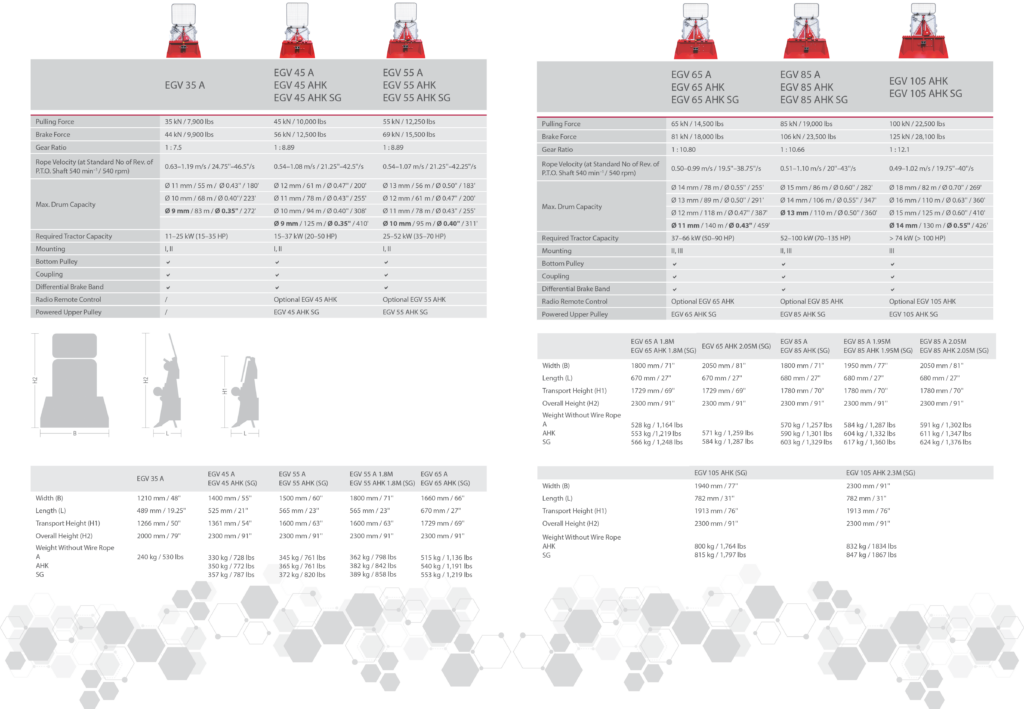
Next, I categorize my tractor by its power rating:
- Heavy-duty: over 100 HP
- Small: 15–35 HP
- Smaller: 20–50 HP
- Medium: 35–70 HP or 50–90 HP
- Larger: 70–135 HP
I then refer to the winch technical specification tables to see which models are suitable for my tractor’s power class.
Now that I’ve narrowed down my options, I can consider a few more useful tips and decide which model best fits my needs.
The winch’s pulling force should match the tractor’s power and weight, as well as the rope’s diameter and length.
Another important factor is the lifting capacity of the tractor’s rear linkage — this tells me how much additional payload I can carry beyond the winch’s own weight.
It’s worth noting that older tractor models are typically heavier — which, in this case, is a benefit. Heavier tractors provide better balance and stability, especially with larger winches.
Always check the winch’s weight as well, since it often reflects the machine’s overall robustness.
If my tractor has front-wheel drive, it will already offer better weight distribution and stability — even more so if I add front weights.
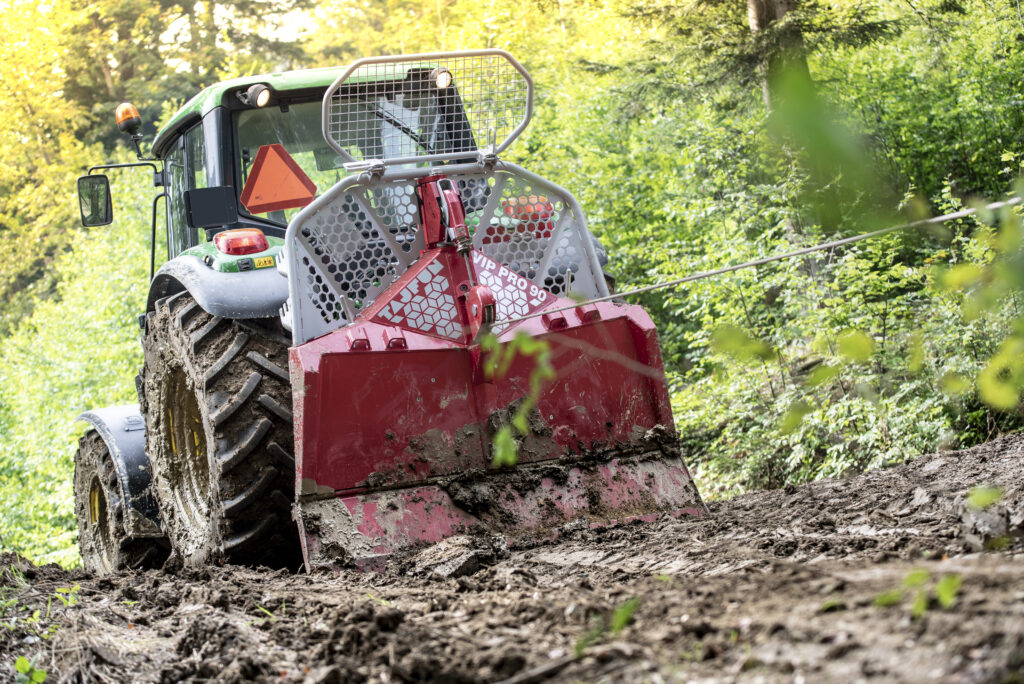
In practical terms, the winch and tractor will operate reliably if the tractor weighs at least half the winch’s rated pulling force. The other half should be ensured with proper anchoring — using support plates or additional anchoring for the tractor.
If I’m mounting the winch on a front linkage, the tractor’s longitudinal stability is greatly improved.
Following these steps gets me much closer to selecting the right winch. But to ensure long-term reliability, efficiency, and above all safety, I must also take into account additional external factors that can significantly affect my future investment in forest operations.
In the next article, I’ll go into more detail on how to choose the right winch based on external conditions — such as terrain, forest size and composition (log diameter), and work intensity.
Stay tuned — in the next post, I’ll share real-world experiences from the field, including practical examples of choosing the right winch.