

 Deutsch
 Slovenščina
HOW TO CHOOSE THE RIGHT FORESTRY WINCH – PART 2
JOS: Practical Advice and First-hand Experience from the Field
As announced in the opening article of the JOS’S TIPPS series, we continue with practical guidance on choosing the right forestry winch. This time, I will focus on selection based on external conditions – terrain, forest size and structure (log diameter), and work intensity. Kako pravilno izbrati dolžino žične vrvi?
HOW TO CHOOSE THE RIGHT WIRE ROPE LENGTH?
The two key factors when determining the required wire rope length are forest road density and terrain slope.
Interestingly, practical experience often shows that a shorter rope on the drum can actually be an advantage. It is easier to ensure proper and tight winding on the drum, and with winches that do not maintain constant pulling force, the pulling force itself is higher when there is less rope on the drum.
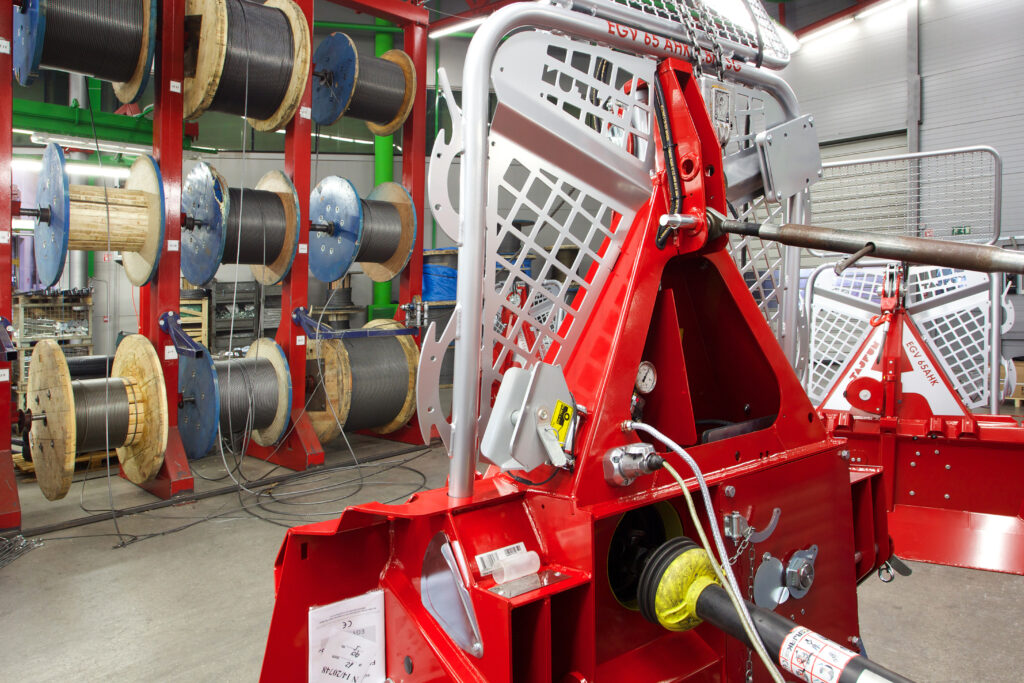
A rope that is too long is difficult to keep evenly wound. This can lead to rope damage, uneven winding, and in practice the rope often breaks somewhere in the middle. For this reason, it is often more practical to occasionally use an extension rope rather than permanently installing an excessively long rope on the drum.
STEEL WIRE ROPE OR SYNTHETIC ROPE?
When choosing the type of rope, forest ground conditions must also be considered.
If the terrain contains a lot of rocks, sharp edges, or exposed stone surfaces, a steel wire rope is often necessary, as synthetic rope can quickly become damaged due to abrasion.
However, if most of the work is carried out on soft terrain such as soil or sand, a synthetic fiber rope may be a good option, as it is lighter to handle and places less strain on the operator’s back.
If you plan to use a steel wire rope, a rope unwinding system is highly recommended despite the additional cost, as it:
- extends rope service life,
- reduces operator physical strain,
- speeds up work.
WHAT ABOUT ROPE ACCESSORIES?
When selecting suitable rope-end equipment, it is important to consider the type of logs you will most frequently extract.
If you mainly handle larger-diameter logs and usually extract one or two at a time, a sliding hook with a choker is a practical solution.
If the logs are smaller and multiple logs are extracted at once, it is more efficient to use several sliding chokers along the rope and a parallel hook at the end, or alternatively a wedge socket. This makes attachment faster and improves overall work efficiency.
I will share more practical advice on rope selection, maintenance, and proper use in one of the upcoming articles.
BASIC OR PROFESSIONAL WINCH?
How much time do I actually spend working in the forest?
This is the key question when deciding between a basic winch, a winch with additional features, or a professional forestry winch.
Forest size is important mainly because it helps estimate how many days per year the winch will be used. Will it be one week per year, one month, half a year, or even more?
Fewer working days usually mean that a simpler mechanical winch is sufficient. However, if forestry work is more frequent, it makes sense to consider an electrohydraulic winch with radio remote control, as it enables faster, safer, and less physically demanding work over time.
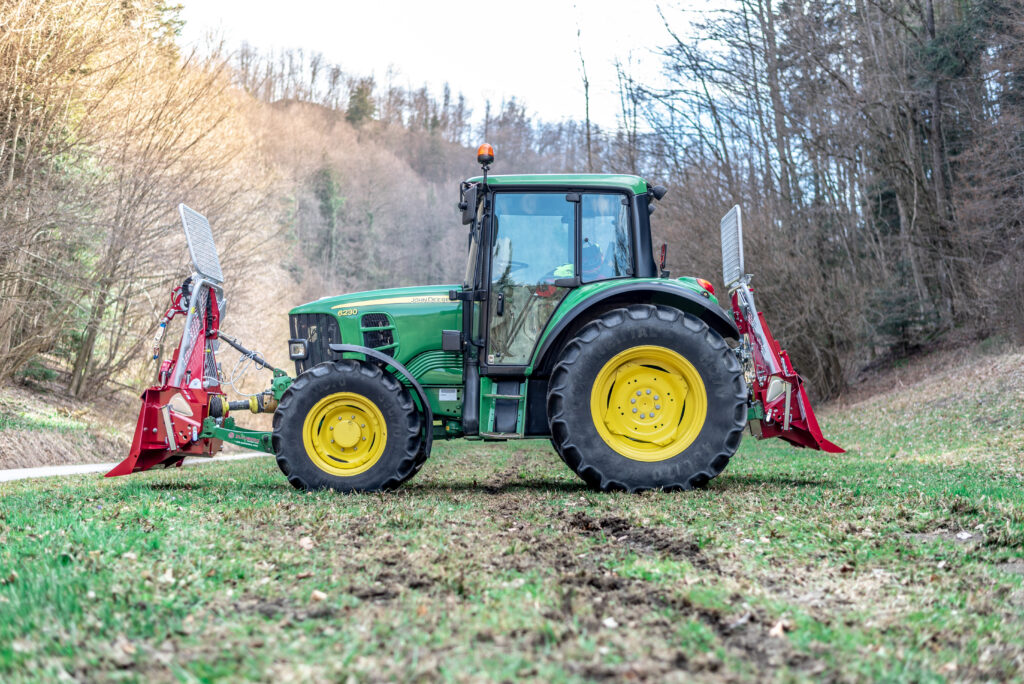
PRACTICAL EXAMPLES: CHOOSING A WINCH BASED ON TRACTOR SIZE AND WORKLOAD
To simplify things, here are some typical examples from practice:
- Small tractors up to 35 HP, log diameter approx. 30–40 cm, short extraction distances, and only a few working days per year in a small forest (1–2 ha):
a winch with 35 or 45 kN pulling force is sufficient. - Tractors from 20 to 50 HP under similar working conditions, with up to one or two weeks of annual use: a 45 kN winch is adequate.
Control options include mechanical control (simple and most economical) or electrohydraulic control, which can later be upgraded with radio remote control. Advanced control systems become particularly useful when working more than two weeks per year. With mechanical or cable control, two operators are usually required, and communication errors can quickly lead to accidents. - Tractors between 35 and 70 HP are suitable for winches with approx. 55 kN pulling force. For lighter workloads, either mechanical or cable-controlled electrohydraulic winches are appropriate.
- Tractors between 50 and 90 HP match well with winches of at least 65 kN pulling force. For occasional use (up to two weeks per year), mechanical or cable-controlled electrohydraulic winches are sufficient. With radio remote control, however, these winches are also suitable for professional applications.
- Tractors between 70 and 135 HP are best paired with winches of approx. 85 kN pulling force. These are already professional-grade machines, so mechanical control is generally no longer recommended.
- For large tractors above 100 HP, I recommend winches with 90 or 105 kN pulling force. In this category, depending on terrain conditions and workload diversity, double-drum winches may also be considered.
WHY CHOOSE ELECTROHYDRAULIC AND RADIO REMOTE CONTROL?
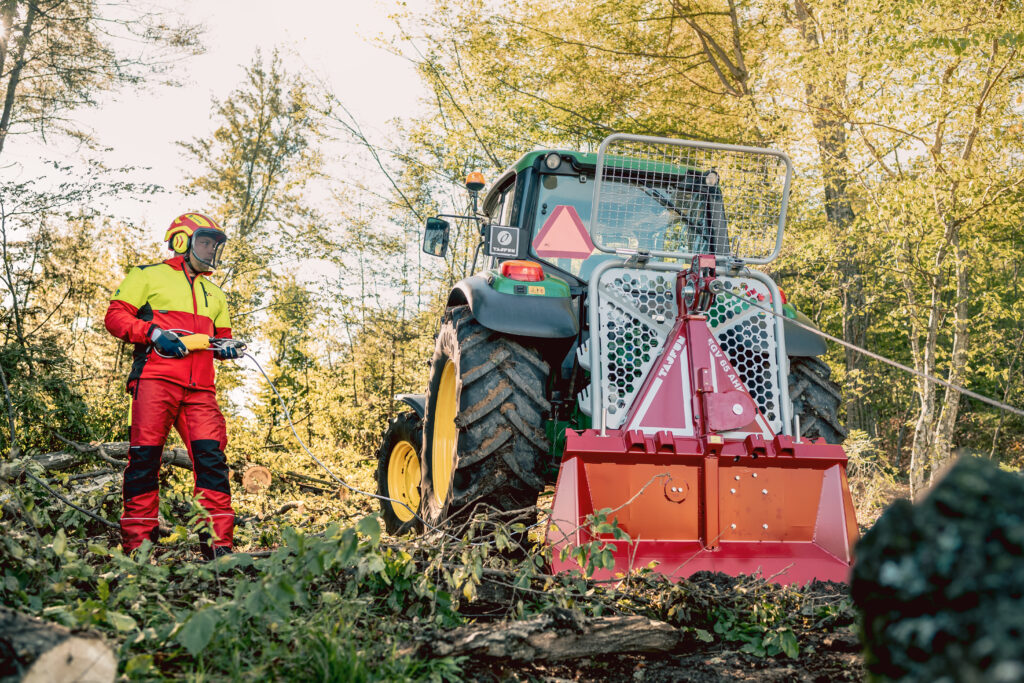
If you choose an electrohydraulic winch control system – now standard on larger winches – I strongly recommend adding radio remote control. The benefits are clear:
- improved safety,
- operation by a single operator,
- better ergonomics,
- faster work,
- higher productivity,
- more economical operation.
IF YOU ALREADY OWN A WINCH AND ARE BUYING A NEW ONE
If you are replacing an existing winch, the decision is usually much easier. You already know the performance of your current machine, understand your needs, and know what you would like to improve.
This often leads to a more informed and accurate purchase decision compared to buying your first winch.
KNOWLEDGE – AN IMPORTANT FACTOR BEFORE BUYING A WINCH
One aspect that is often underestimated when purchasing a (first) forestry winch is operator knowledge.
If you do not yet have sufficient forestry experience, or if you are unsure about your skills, attending a forestry training course is highly recommended.
I also always advise carefully reading the installation and operating instructions before using the winch and watching instructional videos – even if you already have experience working with winches.
Proper knowledge and correct equipment use significantly reduce the risk of serious accidents in the forest.
In the next article, I will take a closer look at a very important winch component – the clutch and brake system – which play a major role in safety, service life, and operator comfort.
Stay with me in the next installment, where I will share additional field experience and practical tips from everyday forestry work.