Deutsch
 Slovenščina
HOW TO CHOOSE THE RIGHT FORESTRY WINCH – Part 3
JOS: Practical Advice and First-hand Experience from the Field
In the previous article, we discussed selecting a winch based on the tractor, terrain, rope length, and work intensity. This time, I will focus on two winch components that users often take for granted, but which actually have a major impact on safety, reliability, and the service life of the winch: the clutch and the brake.
WHY DOES A FORESTRY WINCH NEED A CLUTCH?
Several years ago, while testing our winches in Germany, I visited one of our customers in Bavaria. During our conversation, he praised our winch and then added that he had built an even better one himself using an old truck differential. He told me the winch was “infinitely powerful” and that it had “only” overturned his tractor three times.
The reason was simple: the winch had no clutch.
This story perfectly illustrates why a modern forestry winch needs a high-quality clutch. Its purpose is not only to transmit power but also to protect the entire system from overload.
HOW DOES A CLUTCH WORK?
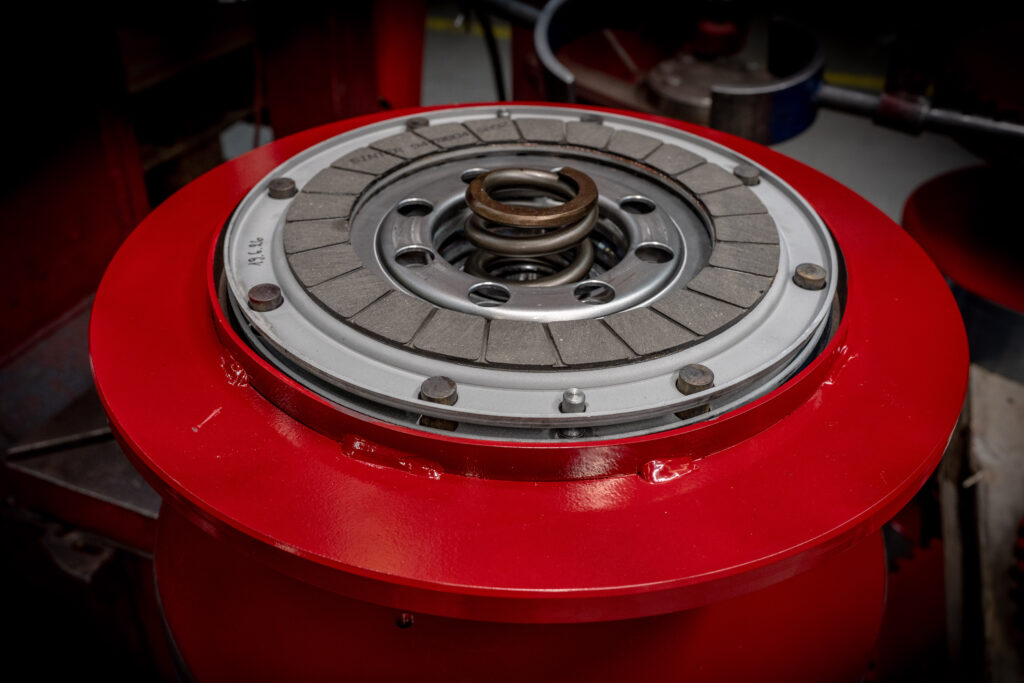
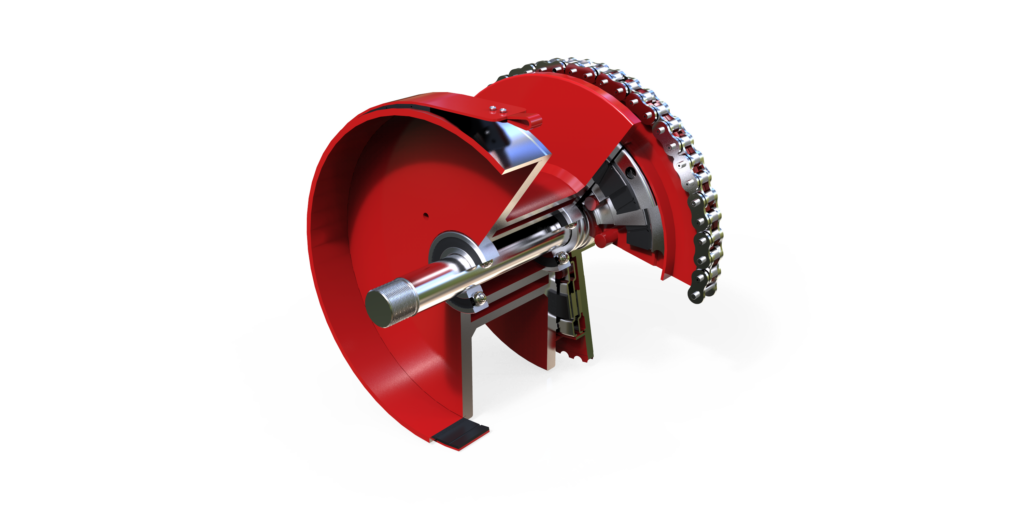
Most users are familiar with a clutch from a car. In a so-called dry clutch, a friction lining is pressed between two metal surfaces. When the clutch is engaged, friction between the surfaces enables the transmission of torque and rotational movement.
Since the engagement force is limited, the clutch slips when overloaded. At that point, power transmission is interrupted or reduced, protecting both the winch drive components and the tractor.
Simply put: if the clutch slips, it is warning you that it has been overloaded.
In such a case, you should not look for ways to increase the load on the winch even further – instead, you should disconnect part of the load.
If the clutch slips, release part of the load!
This is one of the basic rules for safe winch operation.
WHY IS CLUTCH SIZE IMPORTANT?
When choosing the right wire rope accessories, it is important to consider the type of logs you will be skidding most often.
The same simple rule applies to clutches: the larger the friction surface, the lower the load on each individual lining.
Torque transmission depends on:
- engagement force,
- the size of the friction surfaces.
If the clutch has more friction linings or a larger working surface, it can transmit the same torque with less load on each individual component.
The result is:
- less wear,
- lower temperatures,
- longer service life of the entire system.
Simply put:
More friction linings mean a longer service life.
HOW LONG DOES A CLUTCH LAST?
Many people believe that clutches are consumable components that need frequent replacement. In practice, however, a high-quality clutch can last an exceptionally long time when used correctly.
I remember a customer who brought in one of our dual-drum winches for service because, as he put it, the winch was “not pulling properly.” After inspection, we found that the issue was not clutch wear but excessive lubrication of the chain. Grease had reached the clutch friction linings and reduced friction.
The most interesting fact was that this winch had already extracted approximately 40,000 cubic metres of timber.
The thickness of the friction linings was still practically the same as on a new winch.
This clearly shows that, under normal operating conditions, clutch linings experience very little wear because slippage occurs only exceptionally and for a very short time.
WHAT IS THE PURPOSE OF THE BRAKE?
The second important component of a winch is the brake.
Most modern forestry winches use a band brake, which, for safety and operational reasons, is designed to hold at least 25% more force than the winch’s rated pulling force.
In forestry winches, we primarily refer to it as a parking brake.
When the brake is engaged, the band tightly grips the drum and holds it in place. It works similarly to a strap oil filter wrench that wraps around the filter and prevents it from rotating.
This means that the operator can pull logs towards the landing area alongside a forest road using only the brake, while the drum remains securely locked.
When the brake is released, the wire rope can be unwound. This is done manually or with the help of rope payout systems, always under the operator’s control.
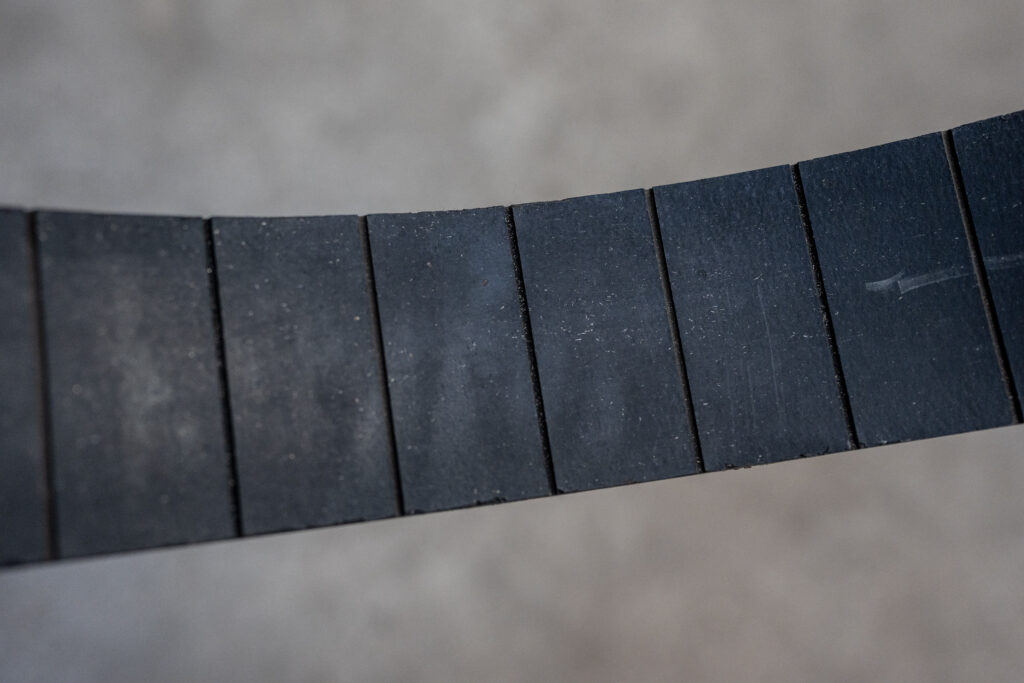
THE IMPORTANCE OF HIGH-QUALITY FRICTION LININGS
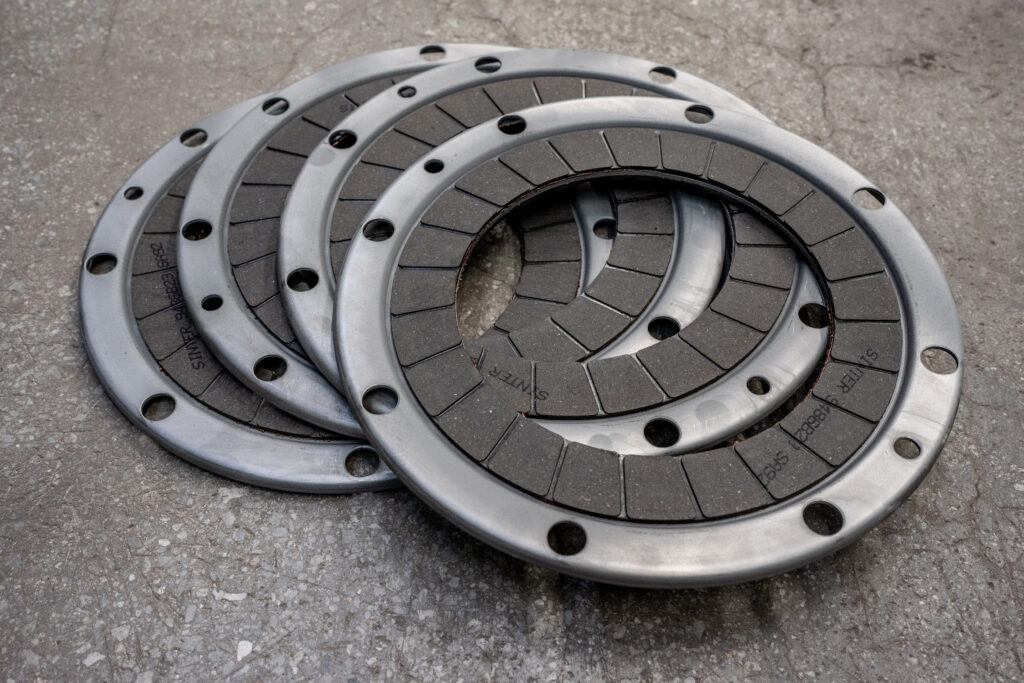
Clutch and brake friction linings are made from special materials designed for demanding working conditions.
They no longer contain asbestos, which was once commonly used but is now prohibited due to health risks.
Linings differ according to:
- their intended purpose (clutch or brake),
- material composition,
- reinforcement type,
- the presence of cleaning grooves.
In band brakes, cleaning grooves are highly beneficial. During extended periods of inactivity, the drum surface can oxidise, and the grooves quickly clean the contact surface when operation begins, ensuring reliable brake performance.
WHAT HAPPENS IF THE CLUTCH OR BRAKE SLIPS?
Every instance of slippage creates friction. Every friction force generates heat. Short-term slippage is completely normal during operation, but prolonged slippage can cause serious damage.
If you notice any of the following during operation:
- a strong burning smell,
- blue smoke coming from the winch,
- unusual overheating,
there is a high probability that the friction linings have overheated.
In such cases, the linings are likely damaged, and a service inspection and replacement of the clutch or other worn components will be necessary.
Therefore, never ignore the warning signs your machine gives you.
THE CLUTCH AND BRAKE ARE NOT JUST TECHNICAL DETAILS
Users often pay the most attention to pulling force, rope length, or radio remote control. However, it is precisely the clutch and brake that work behind the scenes every day to ensure safety, protect the machine, and guarantee reliable operation.
A well-designed clutch protects the winch from overload, while a high-quality brake ensures safe control of the load.
When we talk about a high-quality forestry winch, we are not talking only about the number of kilonewtons of pulling force, but also about the solutions that enable safe and reliable long-term operation.
In the next article, we will focus on another important aspect of the winch – the wire rope, its selection, maintenance, and proper use, as the rope represents the direct connection between the winch and the timber being extracted from the forest.